Private charging
Review connector type, advertised output, sample energy pricing and property amenities before requesting a session.

EVroam / Product case study
An EV stop can be more than a place to plug in. EVroam brings private charging, stays, dining and lounge discovery into one travel companion—with a dedicated workspace for the people hosting those stops.
A functional, device-local Kotlin Multiplatform prototype by Kahol Labs. All locations, availability and rates shown are illustrative.
 EVroamCharge · Stay · Explore
01 / The opportunity
Charging is one part of an EV journey. The people in the vehicle still need a place to rest, something to eat, and enough information to decide whether a stop fits their plans.
EVroam explores a connected experience: discover a private charger, understand the property around it, and choose the services that make the stop useful. A café visit, a lounge session or a one-night stay can be considered alongside charging.
The other side is equally important. Hosts need to describe their property, manage individual services, set prices and sessions, and respond clearly to guest requests. The prototype brings both perspectives into the same shared product.
02 / The product idea
Four separately modelled services give the journey structure. A charging session, room, meal and lounge reservation have different units, prices and availability rules.
Review connector type, advertised output, sample energy pricing and property amenities before requesting a session.
Discover an associated property and reserve one room for one night within the current demo model.
Choose a sample café or dining session, with per-person pricing and a party size of up to six.
Explore lounge or rest sessions as a service in its own right, rather than assuming every charging stop includes it.
Private chargers support local demo reservations. Commercial stations are discovery and external-map destinations only; the prototype does not offer bookings with those operators.
03 / Two sides of the experience
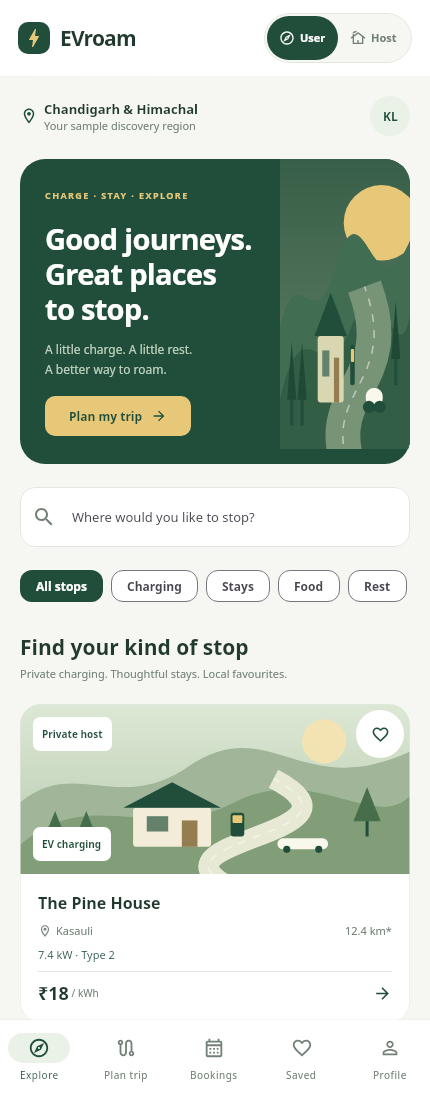
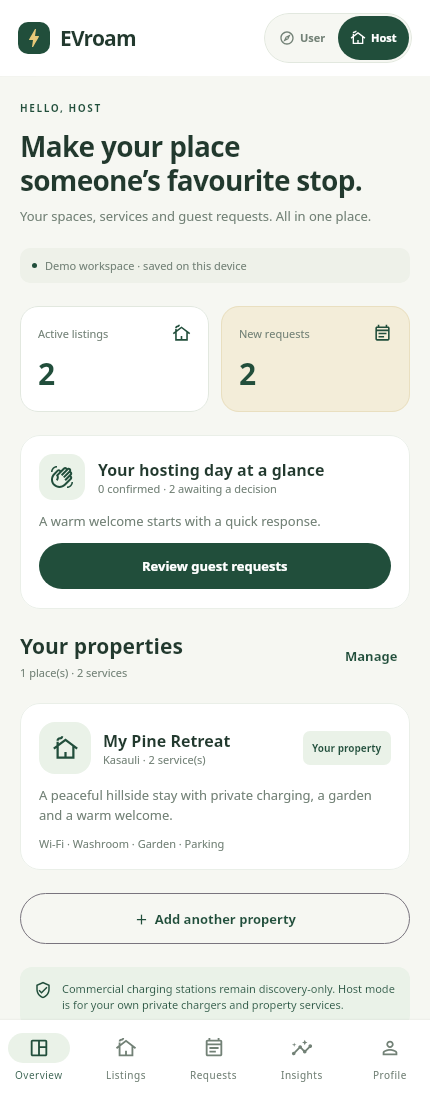
Switch between the traveller and host views below. These are existing native UI renders from the shared Compose implementation—not a connected booking service.
Search the sample network by city or name, explore charging and hospitality categories, save useful places, and inspect the details before deciding what to reserve.
Map links open the platform’s external map app. Sample distances are not GPS-derived and listed stops are not matched to a calculated route.
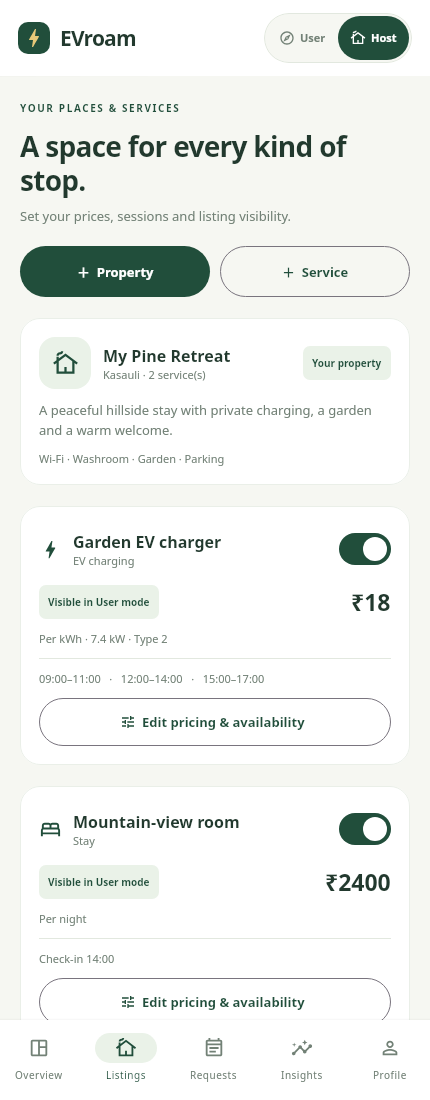
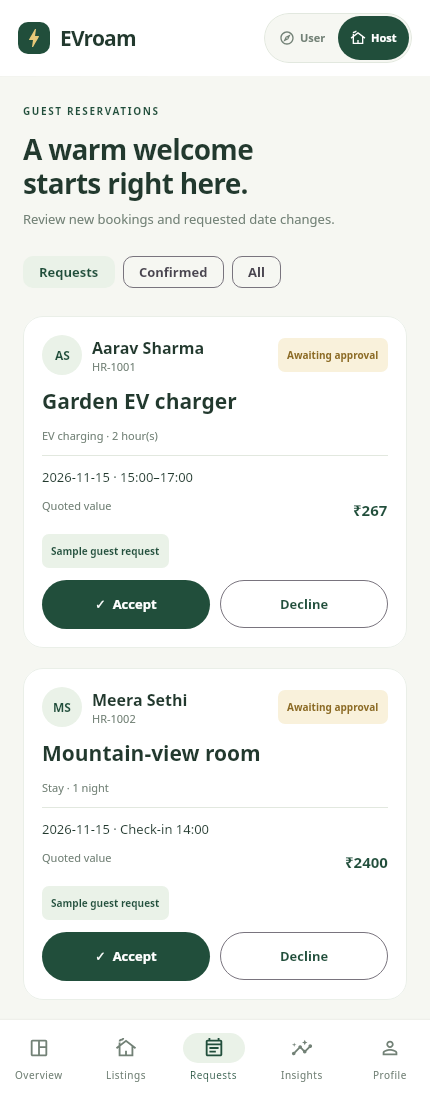
Give a property its own identity, then manage the services that belong to it. Hosts can set sample prices and sessions, pause a listing, and review booking or reschedule requests.
Switching modes is a saved UI preference, not account authorisation. Host and traveller decisions update the same device-local demo store.
04 / Reservation design
The shared repository models reservation states explicitly. That gives both sides a consistent way to understand the next step, even in a local prototype.
A reschedule request stores the proposed date and session separately. The original reservation remains the reference until a host decision, instead of silently changing a guest’s plan.
Charging checks connector compatibility. Calendar dates, offered sessions and local collisions are validated before saving. Cancellation and request decisions update the relevant local views.
These are on-device rules. They do not lock inventory across customers, verify a real host’s availability or send remote notifications.
05 / Explore the calculation
Try a web interpretation of the app’s shared range calculation. It uses your manual inputs and a 15% battery reserve; it does not geocode a journey or find live chargers.
A 300 km trip exceeds the estimated starting range. The simplified model suggests 1 charging stop.
Weather, elevation, speed, load and charging conditions affect range. Stop count assumes replenishment to full charge. Stop locations, charger availability and charging duration are not calculated.
The sample Pine House charger advertises 7.4 kW at ₹18/kWh. Choose a session to see the prototype’s price estimate.
7.4 kW × hours × ₹18/kWh, rounded up to a whole rupee. Actual metered energy, charging taper, onboard AC limits and losses are not modelled. No booking or payment is made.
06 / Behind the experience
Kotlin Multiplatform holds the models and product rules together. Compose Multiplatform gives the traveller and host experiences a shared interface across the declared targets.
Typed models describe vehicles, properties, chargers, services and reservation states. The repository handles validation, quotes and transitions instead of leaving the rules scattered across screens.
Traveller and Host modes use the same forest, cream and gold visual language. Mobile bottom navigation becomes a sidebar on wider layouts, keeping the product hierarchy consistent.
Android SharedPreferences, iOS NSUserDefaults, browser localStorage and desktop Java Preferences sit behind a common store interface. The data stays local to that installation.
Android and iOS entry points are included, alongside Kotlin/Wasm and an optional desktop runner. Map launching and platform-specific date handling are kept at the edges.
07 / What this case study demonstrates
EVroam demonstrates a two-sided product, shared interface design and explicit reservation rules. It does not represent a live charging network or a released marketplace.
The project’s existing verification notes record shared-domain test runs, Kotlin/Wasm builds and native desktop renders. Android and iOS compilation, physical-device QA and supported-browser interaction testing remain outstanding. The renders shown here are product design evidence, not proof of those device releases.
A production service would need real identity and host ownership, verified listings, remote inventory, authoritative payment and booking events, and guest notifications. The local mode switch would need proper server authorisation, and device-only slot checks would need distributed reservation control.
Same-day sessions currently do not filter out elapsed times, and stays support one room for one night. These boundaries make the present scope understandable and give the next iteration specific work to prove.
EVroam / By Kahol Labs
From product flows and a shared design language to domain rules and platform boundaries, EVroam shows how a connected idea can become a tangible experience.
Discuss a multiplatform productEVroamCharge. Stay. Explore.